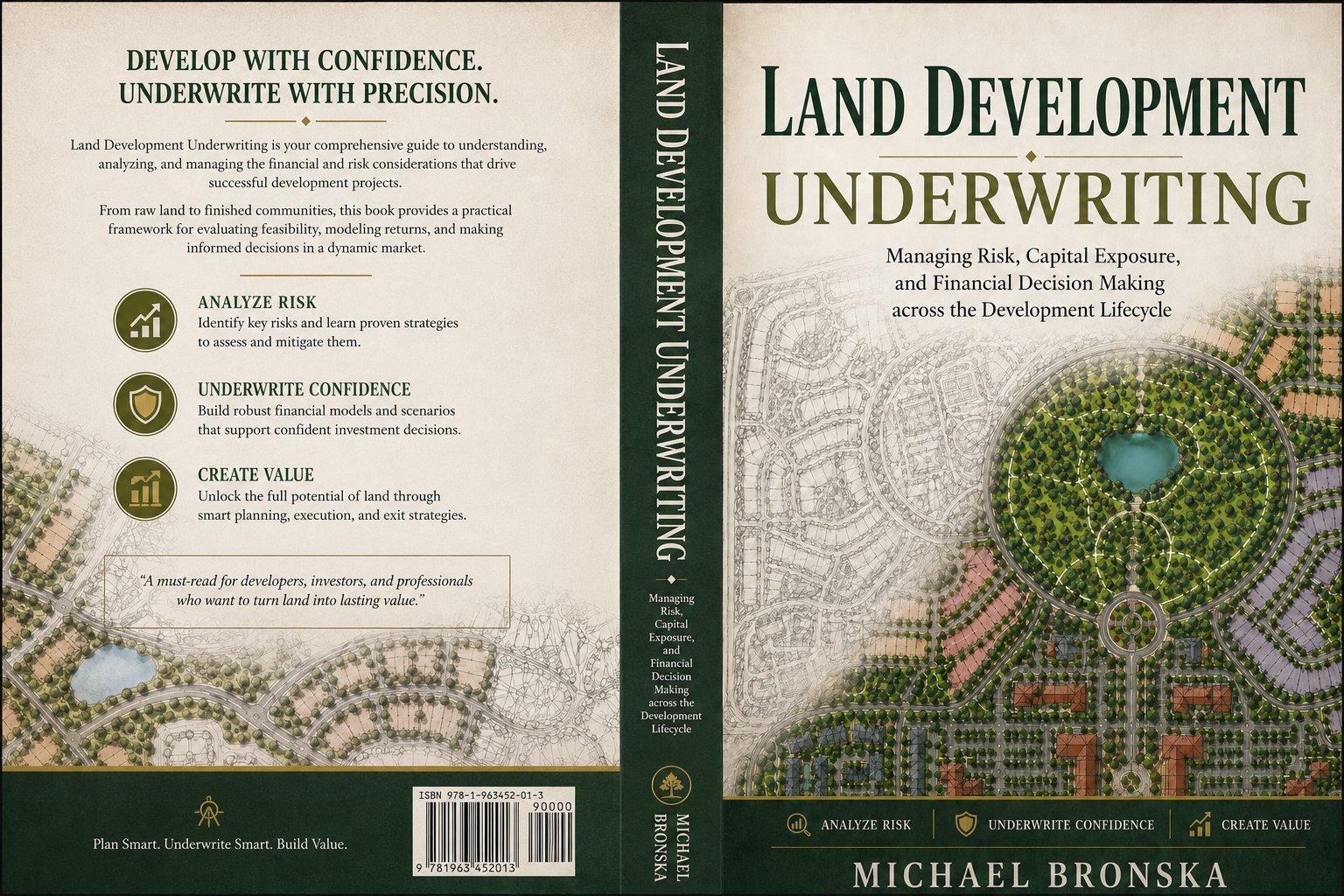
Land Development Underwriting book cover
Available July 2026
ISBN 978-1-963452-01-3
Volume I · 2026

Land Development
Underwriting

The Practice of Land Development Underwriting: Managing Risk, Capital Exposure, and Financial Decision-Making Across the Development Lifecycle

By Michael Bronska · GReAT Real Estate Advisors

Purchase book Available July 2026
Companion Excel workbook Available with book launch
Analyze Risk Identify key risks and learn proven strategies to assess and mitigate them.
Underwrite Confidence Build robust financial models and scenarios that support confident investment decisions.
Create Value Unlock the full potential of land through smart planning, execution, and exit strategies.
About this book

A framework for
structured
skepticism.

Designed for
Graduate programs Institutional sponsors Private equity Development professionals

Land development is a capital allocation strategy executed under uncertainty, with irreversible commitments made long before revenue is realized.

Capital is concentrated early, cash flow is delayed, and the consequences of misaligned assumptions compound across a multi-year horizon. The analytical discipline required to navigate that environment is the subject of this book.

Rather than focusing solely on projected returns, this book presents a rigorous five-part framework for evaluating development opportunities through the lens of risk migration, capital exposure, and lifecycle-based financial modeling. It emphasizes the sequencing of decisions, the magnitude and duration of capital at risk, and the alignment between leverage and project volatility.

The framework moves from conceptual foundation to model construction to institutional interpretation. The residual land value analysis establishes the feasibility boundary before a dollar of capital is committed. The schedule-driven pro forma translates development decisions into time-indexed economics. Fragility testing and sensitivity analysis locate where the project is most exposed — and not just whether the base case works. The decision frameworks throughout the book are grounded in capital preservation and margin of safety, not base-case optimization.

This text positions underwriting not as spreadsheet construction, but as a discipline of structured skepticism. It challenges practitioners to move beyond projected returns and evaluate whether anticipated performance adequately compensates for the capital exposure required to achieve it.

In development, returns are earned only if capital survives the lifecycle. The projects and portfolios that endure cycles — rather than merely survive them — are built on that discipline from the first day of underwriting.

"Does the projected return justify the magnitude, duration, and volatility of capital exposure required to achieve it?"

— The Practice of Land Development Underwriting

The analytical framework

Five parts. One discipline.

Vol. I
01
Conceptual Foundation

Capital allocation under uncertainty. The nature of irreversible commitments and the lifecycle of development risk.

02
Residual Land Value

Establishing the feasibility boundary before a dollar of capital is committed. The starting point of every rigorous analysis.

03
Schedule-Driven Pro Forma

Translating development decisions into time-indexed economics. Capital, cost, and revenue sequenced across the full lifecycle.

04
Fragility & Sensitivity

Locating where the project is most exposed — not just whether the base case works. Stress-testing the assumptions that matter most.

05
Institutional Decision Frameworks

Capital preservation and margin of safety as guiding principles. Evaluating whether return adequately compensates for exposure.

Also in the series

Volume II — Real Estate Financial Analysis as Decision Making
Coming November 2026

View Volume II
Volume I · Michael Bronska

Get your copy of
Land Development
Underwriting.

Available July 2026. Reserve your copy or request the companion Excel workbook.

Purchase book Companion Excel workbook

Both available at July 2026 launch